Thrive Metrics — A Resource

What we measure
is what we protect.

For decades, communities have been asked to squeeze their lives into metrics designed by capital. The Thrive Metrics turn that on its head — a community-defined framework for measuring what actually keeps neighborhoods whole: the right to live, the right to stay and belong, and the right to thrive.

What It Does

A design, learning, and measurement framework.

Thrive Metrics function as governance tools that reflect and shape what communities value. They support communities in designing strategies, learning in real time, and measuring the outcomes the community has defined as success.

01 — Design

A tool for designing

Thrive supports communities to design strategies, solutions, and initiatives that advance their vision for thriving and regeneration. It helps identify the unintended consequences of any strategy or intervention before resources are committed.

02 — Learning

A tool for learning

Thrive supports communities to identify the key indicators of success and gather data that informs learning. It organizes action, reflection, and learning cycles that refine effective practice and improve outcomes in real time.

03 — Measurement

A tool for measuring

Thrive supports communities to identify the measurements that matter most to them, and to track and celebrate progress toward the outcomes the community has defined as the measures of success.

"Metrics are governance mechanisms. If you control what's measured, you control what's valued."

Full Spectrum Labs
The Framework

Three interconnected rights essential for community flourishing.

The framework is structured around three foundational rights. Each right organizes into three subcategories that communities use to set their own indicators based on local context, history, and priorities.

01 — Foundational

The Right to Live

Housing security, public health, and community safety form the bedrock of thriving communities. The other rights depend on this foundation.

  • 1A Physical & Environmental Well-Being Access to clean air, water, and healthy housing as questions of power, dignity, and equity. Environmental harm is often a deliberate outcome of systemic neglect, addressed through transformative infrastructure.
  • 1B Community Safety & Justice Community-led safety infrastructure, restorative practices, and justice as healing. Tracks safety outcomes alongside power redistribution and relational repair.
  • 1C Emotional & Spiritual Wholeness Mental health, collective healing, cultural care, and spiritual wellbeing. Resilience depends on spaces that foster restoration, meaning, and belonging.
02 — Relational

The Right to Stay & Belong

This pillar affirms that communities have a right to remain, to shape their future, and to preserve their collective identity. It centers anti-displacement as a human right and cultural continuity as a source of power.

  • 2A Anti-Displacement & Housing Security Eviction rates, land control, rent burden, and tenant organizing. Stability of place is the anchor of all communities thriving.
  • 2B Cultural Continuity & Narrative Shift Preservation of cultural institutions, local languages, traditional knowledge, and intergenerational continuity. Treats cultural survival and dignity as core to justice.
  • 2C Social Cohesion & Mutual Support Civic trust, neighbor collaboration, and mutual aid networks. Measures the social fabric as infrastructure for collective wellbeing.
03 — Generative

The Right to Thrive

Thriving requires control over land, labor, capital, and the rules of the economy. This pillar covers wealth-building, shared ownership, and the governance structures that allow communities to direct their own resources.

  • 3A Economic Power & Collective Wealth Tracks who owns and controls economic assets, from community-owned housing and co-ops to local procurement systems and shared investment vehicles. Replaces job-growth statistics with measures of circulation, ownership, and retention.
  • 3B Education & Skill Development Education framed as capacity-building for community power. Includes access to culturally relevant education, technical training for cooperative development, and youth leadership pipelines.
  • 3C Governance, Data & Accountability Participatory budgeting, data sovereignty, civic decision-making bodies, and public accountability structures. Affirms that metrics are tools of governance.
The Structure

Universal foundation. Project-specific apex.

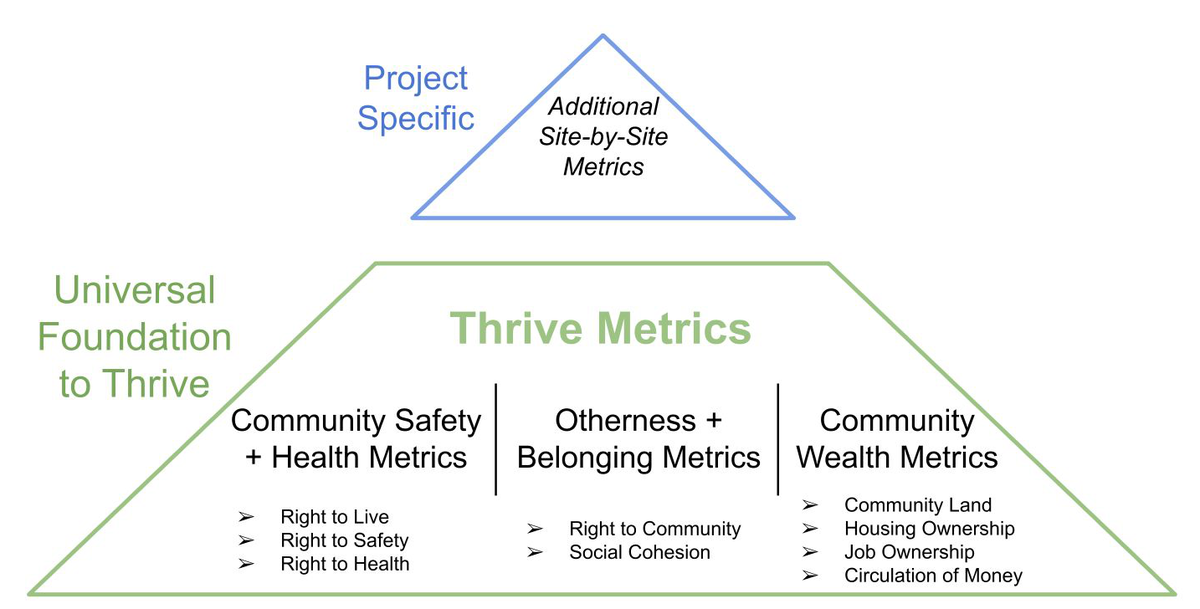
Every project sits on top of the same foundation. The Thrive Metrics are universal — they apply to a housing project in Oakland, an energy cooperative in the Amazon, a food sovereignty initiative in Newark. On top of that foundation, each project layers its own site-specific metrics.

Thrive Metrics pyramid: a large green trapezoid labelled Universal Foundation to Thrive contains three columns (Community Safety + Health Metrics, Otherness + Belonging Metrics, Community Wealth Metrics). A smaller blue triangle above it is labelled Project Specific with Additional Site-by-Site Metrics inside.

The Thrive Metrics framework — Full Spectrum Labs & Justice Capital

Universal Foundation to Thrive

The three rights apply everywhere capital touches community. They are the precondition for any honest impact claim.

Project Specific

Site-by-site metrics tailored to each investment — meaningful only when the foundation underneath them holds.

The Operating Logic

Targeted Universalism: name universal outcomes, identify the specific barriers, design targeted interventions to get there.

The Operating Structure

Power, level, and stage.

The 3×2×4 structure operationalizes the Thrive philosophy into an applicable framework. Each metric is categorized along three axes: the type of power it shifts, the scale it addresses, and the stage of transformation it reflects.

3 Types of Power

What type of power does it shift?

  • Economic. When the metric shifts community access or control over resources, wealth-building, assets, fair wages, or local ownership.
  • Cultural. When the metric protects or builds the expression of identity, belonging, narrative, or cultural creation in a community.
  • Political. When the metric shifts community governance, policy, civic participation, or decision-making authority.
2 Levels

What level does it address?

  • People-based. Outcomes or conditions tied to individuals or households, such as wages, cultural identity, or civic leadership.
  • Place-based. Conditions rooted in the physical, environmental, or infrastructural context of neighborhoods, ecosystems, or land.
4 Stages

Which stage does it correspond to?

  1. 01
    Crisis to Secure. Focus is on meeting basic needs and stabilizing essential infrastructure. Progress is largely reactive.
  2. 02
    Quality of Life. Institutional structures stabilize. Essential systems function consistently. Equity issues are recognized and partly addressed.
  3. 03
    Growth. Systems evolve toward resilience and inclusivity. Local leadership shapes policy. Communities move from maintenance into capacity-building and innovation.
  4. 04
    Full Thrive. Regenerative, resilient systems sustain progress. Equity is institutionalized. Residents express high trust, belonging, and collective efficacy.

Why tag at all?

Tagging enables strategic pivoting and gap analysis. If most indicators sit at Crisis to Secure, the community needs baseline investments. If few metrics address Cultural Power, that may reveal a missing dimension in local efforts. Keystone metrics that address multiple power dimensions often carry compound tags such as Economic-Cultural-Political, because transformative change requires integrated solutions.

How It Works

From baseline to accountable capital.

Meet community where they are

Communities are asked, at their stage of development, what success means and what they need.

Set the foundation

Thrive Metrics establish a universal baseline across safety, belonging, and wealth — before project-specific outcomes are written.

Target the barriers

Funders and stewards apply Targeted Universalism — naming the specific obstacles and the capital structures that overcome them.

Measure what matters

Outcomes are tracked against the foundation. Projects that erode it are corrected. Those that strengthen it are scaled.

In Practice

Community-led applications of the framework.

Two community-led applications of Thrive Metrics that have shaped capital and policy decisions through the framework's three rights.

Right to Stay & Belong Berkeley, CA

Healthy Black Families & the Right to Return

23.5% → <10% Berkeley's Black population, 1970 to 2019

Berkeley's Black community, led by activists and community-based organizations such as Healthy Black Families (HBF), advocated for reparation and a Right to Return for those displaced over the years. By 2022, HBF, the City of Berkeley, the East Bay Community Law Center, and other local partners had developed a policy agenda rooted in extensive input from the Black community. In 2023 the city adopted the Affordable Housing Preference Policy, its first policy to directly address its role in the displacement of Black families.

  • Prioritizes displaced or at-risk residents in affordable housing lotteries
  • Particularly residents affected by government actions during BART construction and redlining
  • Complemented by targeted investments in Black homeownership, cultural institutions, and economic opportunity
Right to Thrive · Data Governance East Oakland, CA

The 40x40 Data Trust & Rise East

400+ East Oakland residents co-designing the metrics

Rise East, a community-led initiative in East Oakland, has engaged over 400 residents in developing local priorities and metrics that emphasize cultural empowerment, economic sovereignty, and political autonomy. Through the 40x40 Data Trust, residents identified indicators such as the number of Black-owned businesses, rates of family displacement and residential turnover, youth access to culturally affirming education, and the presence of community-controlled assets like land trusts and cooperative housing.

  • Community-defined indicators guide public and philanthropic investment decisions
  • Integrates National Equity Atlas economic metrics with Othering & Belonging Institute measures of trust and participation
  • Centralizes a data "Learning System" that enables real-time adjustment of programs and strategies
Who It's For

A shared language for two sides of the table.

The Thrive Metrics are designed to align capital stewards with the communities they intend to benefit — and to ensure community stewards are recognized for the true and complete value they create.

For Capital Stewards

Plan, structure, measure with integrity

  • Align grants, recoverable grants, loans, and equity with what communities actually need
  • Understand each community's stage of development before deploying capital
  • Replace inherited metrics with a framework that tracks foundational outcomes first
  • Use Full Spectrum Capital to support both residence and growth
For Community Stewards

Be funded for the value you actually create

  • Define success in your own language, rooted in your own context
  • Articulate capital needs across operational and project categories
  • Track progress against indicators that reflect community wellbeing, not just project outputs
  • Build accountability into every funder relationship from day one
Origins

Built from decades of frontline practice.

The Thrive Metrics grew out of early collaborations between Movement Strategy Center, Causa Justa::Just Cause, PolicyLink, and others working to address development without displacement, especially in high-risk neighborhoods such as Deep East Oakland and across the Bay Area.

Through the Thriving Bay Area Indicators Project, partners analyzed over 250 potential metrics and narrowed them to 10 Keystone Indicators chosen for their predictive power in identifying community health and vulnerability to displacement. The framework is rooted in aligned principles of Health and Racial Justice, Just Transition, Restorative Economics, and Abolition.

"Thrive is meant to interrupt, with a disciplined practice of conscious action and reflection. Not just from caterpillar to bigger caterpillar, but into butterflies."

Taj James, Full Spectrum Labs
250+
Indicators reviewed
10
Keystone indicators
3×2×4
Operating structure
Dominator → Partnership

From dominator to partnership logic.

Traditional evaluation frameworks typically embody a dominator logic characterized by control, exclusion, and extraction, which reinforces systemic inequities and undermines community empowerment. Thrive Metrics adopts a partnership logic that emphasizes relational interconnectedness, community ownership, and collective well-being.

Traditional
  • Top-down, technocratic
  • Efficiency, growth, extraction
  • Accountable to funders & policy
  • Objective measures only
Thrive
  • Community-driven, participatory
  • Equity, resilience, community wealth
  • Accountable to local communities
  • Integrates narrative & objective data
Full Spectrum Labs Justice Capital Movement Strategy Center Causa Justa::Just Cause PolicyLink Othering & Belonging Institute UC Berkeley Haas Institute USC Equity Research
Get Started

What we measure becomes what we build.

Whether you're structuring a new fund, evaluating a portfolio, or defining your community's needs — Blueprint helps you put the Thrive Metrics at the foundation of every capital decision.

Request access → Schedule a conversation